
Alberta’s Autism Community Pulls Together in Support of Fire-Affected Families

 Thank you all for your outpouring of concern and support for Alberta’s wildfire evacuees.
If You Are in Need
If You Want to Help
Thank you, Alberta! Stay strong and we’ll get through this together.
Our Grade One Experience
 Last summer I was so worried about Conor’s transition to Grade 1: the full days, more academic demands, eating lunch at school, recess. Of all these, recess was the one that scared me the most: would be on his own, was he able to make a friend to play with, would he run? So many scary thoughts.
Of course, it has not all been smooth sailing. His teacher and I brainstorm regularly to help him regulate and stay focused on tasks. Every week I have a copy of their schedule, and I load it onto his iPad so we can chat about the school day. I have advance notice about any changes to their day, and whether there will be a substitute teacher or aide. A “quiet corner” has been set up in his classroom, and there is the option of working outside the classroom to help with regulation. And of course, he can access the sensory room whenever he needs it.
I have also had to address quite a few social skills issues. I did a presentation to his class on ASD to help them to understand some of the “whys” with Conor’s behaviour. I contacted our school liaison worker to source out additional support when he is at school. I volunteer as much as I can to give back, and have met with the Principal and Vice Principals just to let them know who I am and to advocate for my son. I know I need to be a presence in the school for as long as he is there.
 I am very happy to say that I am not dreading Grade 2, because I now know what we need to do to be prepared for the new school year. I’ll update my “All About Me” folder and letters to staff and parents. Over the summer break we will continue to work on academics (a little every day), keep a bit of a schedule, attend a summer camp, and continue to work on social skills and regulation. But we will always keep in mind that he still needs to enjoy his summer and have fun, just like any other child.
Central Alberta Movie Showing: Jack of the Red Hearts

Using the HALT Strategy to Increase Staff Empathy and Support Students

|
Student Need
|
Examples of Staff Responses
|
|
Hungry
|
Allow student to eat some or all of their food as needed. We are able to source additional food for snacks.
|
|
Angry
|
Give the student a chance to go to the gym, ride on a stationary bike, play sports or play a relaxing game.
|
|
Lonely
|
Provide opportunity for social interactions/games (e.g. Rainbow Loom, floor puzzles, or Lego with a classmate).
|
|
Tired
|
Offer rest in a bean bag chair or on a mat to reset the body to move forward.
|
 This is always the first question, and the student is allowed to eat all of his lunch if necessary. Our classroom team would rather the student eat all his food and be full, even if it means sourcing extra food for his lunch later in the day, instead of regulating how much he eats while he is displaying anxious and aggressive behaviour. After he has eaten, staff reassess his ability to move on with classroom activities. HALT plays a vital role as staff ask questions to uncover more information regarding his presentation and needs.
Sue Thomas is an Educational Assistant with over twenty-five years of experience. She has a passion for working with children and adults with autism. Gerry Gabrielle is an Educational Assistant with a dynamic background, working with special needs children and adults in the classroom setting and in care facilities. Myles Bingham is a classroom teacher with a Master’s of Education Psychology with a focus on Special Education. As a part of Institutional Services Schools within the Edmonton Public School Board, this team works to support positive behaviour and build life skills for success in school and in the community.
The Light of My Life
 January 30, 2012 was the day my son Joshua was born. It was one of the happiest days of my life, along with the birth of my first son. What I didn’t know then was that my new son would soon be teaching me the meaning of life.
 We have always treated him equally, and have never limited him. We have gone camping, visited busy malls, attended events, visited attractions, and taken long car rides and flights across Alberta and Canada. Some days it was rough, and yes, some days I wanted to give up, but I couldn’t. If I did, what kind of example would I have set for my sons? We don’t give up in this household – we improvise. If my son needs his music, air purifier and story theater in order to sleep, so be it. If we need to sing the ABCs a hundred times to get through the day, who cares? And if he needs to spin, jump, flap, rock and roll, well then, sometimes I will join him.
Our house is barely ever quiet these days. His little feet are always moving, and his little voice is always mumbling. Life is chaotic, there is no doubt about that. We suffer through tears, tantrums, sleep, worries, scheduling, fears, acceptance, and more, but I wouldn’t want it any other way. He is the light of my life.
Christine Lutz is the President of the Chinook Autism Society. You can contact the Society at chinookautismsociety@gmail.com, or visit their Facebook group.
Autism x 2: What Happens When Your Second Child Is Diagnosed
Originally published in the Autism Awareness Centre Inc. Blog
 My son Marc was 2 years and 10 months old when he was first diagnosed with autism. I’d had clues: Marc wasn’t reaching certain developmental milestones like responding to his own name or waving goodbye. When I found out that Marc was on the spectrum I was devastated, but I was also relieved that my second child was a girl, because I thought there was little to no chance of her having autism, too. By the time Julia was 16 months old, I was rethinking that. Like Marc, Julia wasn’t exhibiting age-appropriate behaviour: there was no baby talk and she wasn’t responding to her name. One year after Marc was diagnosed, I was told that my second child was also on the spectrum. I will never forget the moment I received the diagnosis. I went through so many emotions and felt life was being completely unfair to me. I was full of resentment over having a second child with autism. The second diagnosis seemed impossible – how could this happen in one family?
 Julia, two years Marc’s junior, had the same language difficulty and also didn’t speak until nearly age 5. She would fall asleep at night, but wake at 2 AM as if it were morning and run around the house like a whirlwind. She had more imaginative play, concentrating on figurines and dolls. Julia was not a stimmer. She was more stubborn than Marc, and socially anxious and withdrawn. Julia would hold on to my leg all day. It took one year of therapy to successfully get her out of the house to do outings. She followed the same diet as Marc but would not eat the same foods within the diet. She was hyposensitive, requiring a high degree of input, and had a high pain tolerance.
 They are best friends and rarely have a disagreement. They are interested in each other’s passions. They are willing to try what makes the other one happy. The most important thing for them is to be together, whatever the activity. Even though they have such different needs, I am impressed how they fold into each other’s daily routines. Julia takes on more of a caregiver role with Marc, and he is happy to be cared for by her. Marc can interpret every whine and facial expression Julia makes, and she does the same for him.
We Want to Hear From You!
Making Room for Interactions
 Our journey towards integration of students with Autism Spectrum Disorder (ASD), acquired brain injury, and Fetal Alcohol Spectrum Disorder into our school posed some unique challenges. The school that we work in serves students with severe behaviour disorders, some of whom are on the spectrum and some of whom are not. All of our students are volatile and violent; in fact, this is the entry requirement to attend our school. In addition, a portion of our school population is involved in gangs and engaged in criminal activities. Adding to these challenges, our students often have mental health diagnoses such as anxiety, Tourette’s syndrome, and manic depression. We have a very complex population of students to manage.
-
The frequency of positive interactions between interaction students and mainstream students has increased
-
Teachers have welcomed interaction students into their classes with mainstream students
-
Interactions students have been able to experience our daily physical activity program, Science Olympics, the Terry Fox Run and other school wide activities
-
Interactions students have participated in off-site field trips including volunteering, newspaper delivery, and skiing
-
Work experience throughout the school has demonstrated to other students that Interactions students have valuable real world skills, and has resulted in increased respect for their abilities rather than their perceived disabilities
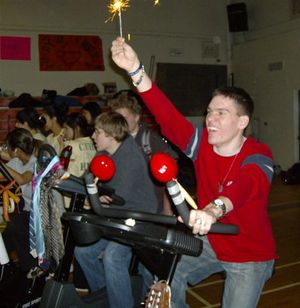 The results from a simple change in location, coupled with staff support and a welcoming school atmosphere, have demonstrated that sometimes simple changes can have a profound impact on school culture. By bringing our interactions students into the building, we have created an atmosphere of belonging instead of exclusion. We have fostered the building of relationships between Interactions students and our mainstream population. We have allowed both groups of students to increase their tolerance for people who are different than themselves. This has been a valuable learning experience.
Sometimes school change is possible without big budgets or extra resources. Sometimes we have to reframe our thinking about what is possible, and take a small first step. When we take these small steps, it may allow everyone to start to think differently about each other and start down the pathway toward increased acceptance. Based on our experience, we would urge schools to implement small, meaningful changes to practice that have the potential to make profound differences in the lives of students diagnosed with Autism Spectrum Disorder.
Gearing Up to Go for the Cycle for Autism

The Cycle for Autism is just around the corner, on Sunday, June 5, in Gold Bar Park!
If you haven’t registered yet, there’s still time – sign up online today! Once you’ve registered, you can add team members, customize your page, and even share through your favorite social media network.
Team members collect pledges and then run, roll, walk or cycle to raise money for Autism Edmonton: a local organization that provides essential information, services and support to people with autism and their families.
We’ve added a third route this year (approx. 3.5kms) that loops into Capilano Park, for those who want to go a little further without doing laps. There will be healthy and fun snacks, Choo-Choo the Clown, a face painter, sensory activities, and MORE!
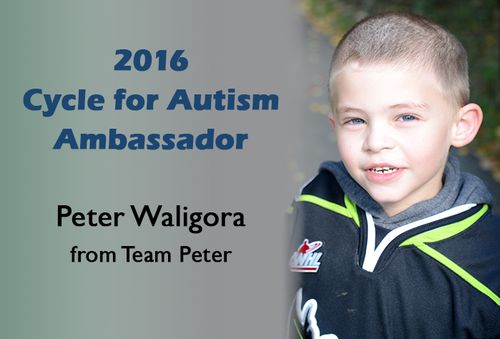
We’re also pleased to introduce our new 2016 Cycle Ambassador: Peter Waligora, from Team Peter. To make the Cycle for Autism event even more meaningful and celebrate those in the autism community who have been involved, he’ll be cutting the ribbon to officially start the ride. Click on the image to see Peter’s story!
With the event coming up on June 5, this is our final drive for pledges. We know resources have been stretched for everyone lately. We also know how much can be accomplished when we all do a small part!
100% of the money raised at Cycle for Autism stays LOCAL and goes towards running and enhancing Autism Edmonton’s programs and services.
Pledge to your favorite team or make a general donation at www.cycleforautismedmonton.com/pledge. You can also donate by cash or cheque to any participating team member (payable to Autism Edmonton – please note the team’s name on the cheque).
We especially want to say THANK YOU to everyone who’s been involved in supporting us: our sponsors, teams, donors, volunteers, and staff.
If you have any questions about what to expect at the event, or what you need to bring, please have a look at the Cycle for Autism FAQs page.
Spread the word – we hope to see you there!
Building Your Transition Team
 When it comes to planning for the transition to adulthood, determining who should be on your transition team is one of the first steps in fulfilling your future vision. Who makes up your transition team will depend on your youth’s goals and aspirations, and may include people such as:
- family members
- representatives from Human Services programs:
-
Your Family Support for Children with Disabilities (FSCD) Worker
-
Persons with Developmental Disabilities (PDD)
-
Assured Income for the Severely Handicapped (AISH)
- Office of the Public Guardian and Trustee (OPGT)
- Alberta Works
-
- representatives from other government or community programs
- Teachers and/or health professionals
- service providers, friends, and others in your community you identify as being important in you or your youth’s life
- What are my goals?
- What skills do I need to learn to reach my goals?
- What local programs, services and supports are available to support me in reaching my goals?
- What responsibilities must school, government, cultural and community agencies, my family and I assume in order for me to reach my goals?
- Are there gaps or barriers to address in order to reach my goals?
From Autism Canada

Autism Canada has watched, from across the country, as events have unfolded as a result of the Fort McMurray wildfire. Our hearts go out to everyone who has been affected, and we applaud those who have come forward to fight this fire and support people in need.
 Over the last two months, we have sent letters and met with the offices of the Ministers of Health, Sports and Persons with Disabilities, and National Revenue. It is imperative that we find solutions at the national level that will have a direct impact on families and people living with autism. These may include making the Disability Tax Credit (DTC) Certificate Application form autism-friendly, or having the next Health Accord include, as a priority, reducing wait times and improving access to autism-specific supports and treatments across the lifespan regardless of the person’s IQ. We were very happy to see Prime Minister Trudeau make mental health a priority in his mandate letter to Minister Philpott. We know that there is a real shortage of professionals that will service people on the spectrum. We have been asked to forward examples of service models that work and we will certainly be doing that.
Find Your Tribe
 About a month ago, I went for coffee with a friend who wanted some help putting together an article about motherhood and autism. I cherish those stolen moments away from the house and into the real world. Somehow, what used to be a simple cup of joe in a chatty, cozy coffee house has become as spectacular as a day at the spa, and sharing that moment with this friend made it even better. She’s the kind of gem everybody wishes they had on their friend list. When you’re with her, you know she’s listening. She’s beyond understanding – and if her experience is different than yours, she’s sincerely empathetic. She’s real. She’s raw. And she’s one of the gift’s I was blessed with when I embarked on the journey of parenting a child with autism.
Thank you, Candice, for sharing this story.
When we were younger than we are today, it was easy to slip into the pre-designed pictures of our futures. Our visions of tomorrow and the days beyond it were pretty, neat and tidy, and full of smiles and laughter. In our imaginative futures we’re surrounded by our friends and creating perfect birthday cakes for our children’s massive birthday parties. We’re sitting in our front yards with a cool drink in our hand, chatting with our neighbours as our children ride their bikes around the neighbourhood. Our friends would gather in our homes as we celebrated the significant successes our children reach – like Kindergarten and driver’s licenses and graduation.
Indeed, that might have been how life used to look. But then one day we find ourselves sitting in a doctor’s office with our perfect little babies on our laps, and we watch the professional’s lips form the word autism.
 There’s really no way to describe the shift in life that happens at that exact moment. Instantly, you gear down. You’re going faster. You’re working harder. Hours upon hours are spent on the computer researching therapies, on the phone arranging appointments and filling out paperwork – all the while grieving the future you never got to see.
 For me, life changed the day I was literally putting one foot in front of the other. My son had taken the bus to his special needs preschool that day, and I was being “brave” by not following the bus right to the door of the school. Instead, I made my way to the gym and jumped on a treadmill. As it happened, the woman on the machine next to me also had a child attending the preschool, and I struck up conversation by asking if she happened to notice if my kid got off the bus.
 It became apparent that there was a world of mothers who knew what it was like to be me. Women who can laugh at the prospects of having adult children living in their basements. Women who build their strength – not because they want a rockin’ body, but because they need to be able to tackle their child should imminent danger appear. Women who will brave the grocery store – not only with their ASD kid, but yours too, because you need that time. Women who sit on your couch with you and cry through your collective laughter and laugh through your messy tears. Women who stand with your husband when you’re not able to. Women who never, ever leave your side.